Christopher Temt

It began with events. In my student years I organised what today would be called raves — a series made with the artist Michael Cranach, Andrea Aichinger and DJ GüMix. The last and largest was the III. Metempsychotische Vermessung: a collaborative exhibition staged as a performance, one night in 1990, filling all the rooms of Schloss Altenberg in Greifenstein — the work of many hands, ours among them. Art was in them from the start.
1984 — Master Degree in Business Administration, University of Economics Vienna. Theory.
Then: over 25 years in a family business. Practice — a company I knew from the inside: its accounts, its prices, its markets, its people. That is where I learned how the market works. And where its limits are.
Since 01.01.1993 I have been working sustainable on the development of my money and time art.
In 2024 I stepped out for good. Since then I work on it exclusively.
In 2026, artificial intelligence was added — without displacing the money and time art. The same question, carried onto new material: how the elements, laws and rules of a system become part of the work itself.
Business is none of Art's business — except Art is using the elements, laws and rules of the market as part of its artistic creation process.
This is my definition of Money Art, and my core practice: it appropriates the laws of the art market and turns them into material for the work itself — a liberating response to the market's attempt to appropriate art.
Eugen Kment

Trained painter.
From 1976 to 1983, a young graphic artist in Munich, living in the Westend, working for advertising agencies and — from around 1979 — for Fix und Foxi. At Comicon (Rolf Kauka), by his own account, he was the "third hand" after Peter Wiechmann and Fred Kipka: he drew few comics himself; his task was to bring an international team of illustrators, scattered across the globe, into one shared style.
For the Rolf Kauka Gold Comic Buch he created the characters Plitsch und Platsch.
Since 1984 his studio was in Lower Austria.
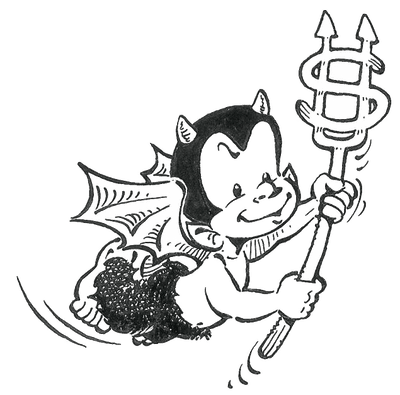
From 1989 to 2006 he drew the cover comic of the Sparefroh magazine — the mascot of the Austrian savings banks, distributed freely in banks and schools. He turned the figure from a thin wire man into a warm, emotional character: a friend of children, and the centre of countless picture stories.
In 1988 he published his own gag series Das kleine grüne Krokodil und seine Freunde at FMZ Verlag.
He illustrated the work of others — among them the parenting guides of Maria Neuberger-Schmidt (Elternwerkstatt) and books by Christian M. Reitterer — and is listed in the Lambiek Comiclopedia, the international record of comic artists.
One drawing sits close to what came later. For the Initiative für Natürliche Wirtschaftsordnung — the movement around Silvio Gesell's idea of money that must keep circulating — he drew Fließendes Geld: a wheel of money running on oil beside a wheel of money grinding to a halt on sand. Money already as his subject.
Advertising work for McDonald's, ATTAC, Benko, Biene Sumsi and others.
Today he lives in Hungary.
Since 01.01.1993, with Christopher Temt, as KMENTEMT.
Art and his suitors

With all its beauty, glamour, power and money, art attracts one to become a part of it. So, you begin your first work of art, and it feels good! One thing leads to the other, the work flows, and the ideas rush down like a waterfall! You are enthusiastic and believe that you are part of something bigger. After finishing your work of art you lean back and think to yourself: “Well done!”
After enjoying this overwhelming feeling, you look up and have the realization, that art, itself, has stolen your work claiming it as its own. It does not belong to you anymore. Instead of being thankful for your gift, art pulls at you and says, “That's it? No way, I want more!”
So you start your next piece and this time it is not so easy. Having lost your innocence, creating turns into hard work. But still, you do your job and create your next work of art, and the next one and the next one. Your life as an artist goes on. You can barely live from it and realize that you have turned into a slave. Art has become the master of your life. But it is ok, because you feel your work (at least sometimes) deals with the fundamental questions of life and the universe.
You get older, while the cost of living continually increases, your responsibilities also increase. You might even have a partner and a child. Your needs have become urgent, yet, the big breakthrough has not come. Daily life is more and more difficult, and more often than not, you are sick of exhausting yourself for art's sake.
That's the moment when compromise appears on your stage and whispers in your ear: “My dear, you do such great work and still you get nothing in return. Take me, and I promise, you will make a living. You might even become famous and rich.” You think of all your unpaid bills and decide, thinking, “This will just be a small compromise. It will do no harm to me and my work.”
The galleries start to exhibit and sell your works of art. You get invited to festivals and are on TV. The “Like It” clicks are increasing like never before. Everything seems to be fine. You can pay your bills and are able to move into a bigger flat.
But compromise is the natural enemy of art. And art is a jealous god who will never accept compromise at his side. Therefore, art will send you — if you are lucky — a child (like in the story of The Emperor's New Clothes) to point out your weaknesses. And if you are unlucky, art will come to you in a nightmare and tell you: “You did me wrong, you did me wrong, you did me wrong…” until you wake up sweating and ask art for forgiveness.
Art might be generous, but it wants something in return. It wants your heart, your mind and even your soul. You will sacrifice everything on the altar of art, because you are addicted to art, to being a slave of the creative process art has bestowed on you and enslaved you with. You can no longer live your life without art. You are like an old junkie who needs his daily dose — not to get high, but to function normally.
From now on you work harder than ever before. You work your fingers to the bone, no longer caring about fame or wealth. Art squeezes you like a lemon — that was the deal — until the last drop of your flow of creativity has finally been sucked out of you. Then, when you have nothing left to say, art spits you out like tasteless rind and turns with all its beauty and power to the next suitor. And the game begins again.
And you? Go cold turkey to kick your addiction and find a regular job (maybe advertising)? If you can't, then you might settle at the boundaries of art as an art teacher — or even worse, as a copyist of your own work.