Why is your homepage so dark?
You should have seen it a month ago — at launch it was almost a black hole.
It is getting lighter, and not by accident. The background turns toward white in steady steps, and will be white by February. The page is not fixed; it changes with time, on its own. What you are looking at is a stage of it, not its final state. The script goes dark earlier than the background — that part is simply so you can read. A page has its limits: it must be legible. But the movement underneath it is the point.
This homepage is part of the artwork. Like the work itself, it is made of days. It accrues; it was not poured out at once. Time does the work on it, in the open — the same way the rule gives each day its price. A site that lightens as the days pass is only being honest about what it is: something that happens in time, not a picture of something already finished.
In this it bows to Roman Opałka. From 1965 to the end of his life he painted numbers counting upward toward infinity, and over the years he mixed a little more white into the gray ground of each canvas — moving toward white on white, what he called the blanc mérité, the earned white. His ground lightened as the work went on. That is the gesture here: a surface that whitens as the days accumulate — a white worked for, not simply switched on. We do it our own way, on a screen, within the plain limits of a page you have to be able to read.
And the light comes from the answers. On LinkedIn they unfold week by week, in a considered order — from the practical, through the institutional, to the theoretical. Read a few, and the dark thins out. That order is not a marketing funnel; it is how the work was actually thought — over years, and not in a day. The gentle reader is led in, not sold to.
The whitening, the timing, the way the page keeps its own clock — conceived and built by Atheer Elobadi.
What exactly is a HoC-print — and what makes it an original?
Three things make a HoC-print: a date, a number, a price. The drawing is the same on every one; the three are not.
The drawing is a 42-panel comic — the History of Creation, from the Big Boing to the present day. Eugen Kment drew it. The same 42 panels appear on every print, in the same arrangement, on hemp paper, 70 × 100 cm. Both artists sign the front — Eugen Kment, Christopher Temt — and the print number sits between them. Everything that identifies the work is on the work itself: no label, no certificate beside it. One work per day, since 01.01.1993 — over 12,000 works exist today.
In one sentence: Money Art is an artwork in which time determines the date, number, and price of every work through a fixed rule.
So — original or reproduction? A fair question. If the artwork were the drawing, it would not be original: a repeated image cannot be original by definition. But the drawing is not the artwork; it is its carrier. The artwork is the day — and the number and price the rule writes onto it: a date that exists exactly once. Both hold at once. The drawing is the reproduction; the day is the original.
That day has a name on the sheet — the Authentic Number. Not a price, not an edition number, not a date, but the work's own coordinate system. The 93 marks the year the rule began, 1993; the figure after the point is the day's position in the unbroken sequence since. 93.100 is day one, 01.01.1993. Subtract 93.100 from any Authentic Number and you have the days elapsed — and so the exact day the work belongs to. Dates can be written many ways; the coordinate cannot. It exists only once. On that first day the value was 100 — 100 ATS. The next work carries 93.101, one unit higher. The rule adds one per day, and has never stopped.
How does the price work — and why in Euro?
The rule sets the price; administration follows around it.
The price shown for a work is the artistic price set by the rule — a net artwork price. It is not a gross consumer price and not a market price. VAT, shipping, customs, import taxes, payment fees and other administrative costs are not part of it, because they are not determined by the artist or by the rule; where they apply, they are calculated and shown separately. The net price belongs to the work: it is not reduced by commissions, mark-ups, or third-party shares. (Merchandising, by contrast, is priced gross, including VAT.)
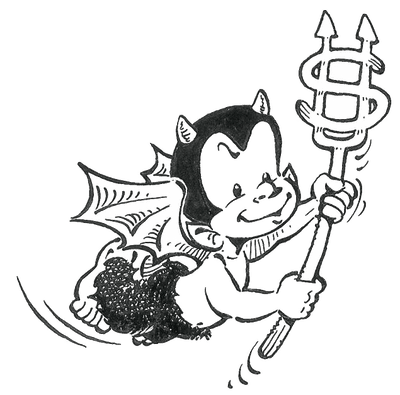
Why not in Dollars, then? Because the Dollar is already taken — by the Devil. Not the biblical one, but Eugen Kment's Money-Art Devil, whose pitchfork is a Dollar sign. The footnote of HoC-print 93.100 says it plainly: at this moment the Devil — in our words, money — started to play a certain role, because you are looking at a piece of money-art. The rule itself never chose a currency. It began in Austrian Schilling on 1 January 1993, rising by one unit each day. A Dollar price would always be a conversion — and conversion belongs to the market. The rule does not.
Austria stopped using the Schilling in 2002. We did not. Since then, HoC-prints have been priced and paid in Euro — but the ATS never left the work. It continues as the rule's original unit and still appears on every print. Over time it took on a new meaning: once Austrian Schilling, today Austrian Solidus, pointing back to the remarkably stable coin from which the Schilling ultimately descends. The currency changed. The rule did not.
Why hemp paper — and what makes the edition sustainable?
Because the material carries the same logic as the work: time. A HoC is not a drawing but a day in material form — and a day happens only once, so the paper that holds it must last. Hemp paper is the material that ensures this duration. It lasts 500 to 1,000 years; a print made today will remain legible for twenty generations or more. You could begin a tradition. The Dunhuang manuscripts — written in China on hemp, sealed in a cave for a thousand years — are still legible today. Permanence is part of the claim.
That permanence is also what we mean by sustainable — and the word means itself twice over. An edition is usually one or the other: limited (a fixed number, then exhausted) or a poster (endlessly reprintable, but without uniqueness). Our rule lifts this either-or: on any single day exactly one work comes into being — limited, this number, this date, unrepeatable — but it is followed, every day after, by a new one, without end, unlimited in time. Scarcity and inexhaustibility hold at once: the single piece stays singular, the series never runs out. The edition does not consume itself like a limited one, nor dilute the work like a poster; it renews itself, day by day, from its own rule.
In this it resists the market and its capitalization at once: scarcity here is not the instrument that drives the price up, but the mere consequence of the rule — the price follows the day, not demand. Sustainable, then, not only over time, but in matter.
Why black and white — and what does a day mean?
Good question to start with. For a painter, colour is the means — the tool through which form, mood and meaning emerge. Red is not just red; it is warmth, danger, passion, one specific red among ten thousand. Our means are different. The story is the same every day. But the day is not. The price is not. The number is not. January 1, 2000 is not the same colour as September 11, 2001; April 19, 1995 is not the same colour as the day your child was born. Each day carries its own weight, its own charge, its own place in history — and, last but not least, your meaning. In that sense the system is anything but monochrome: the colours are not in the ink, they are in time.
This is why every HoC-print carries two stories. The motif tells an innocent one — the History of Creation, 42 panels from the first moment to the present day. The footnote tells another: a system of value, a rule about time — both held together by the Devil. They share a page and share a point: the motif shows where things come from, the footnote what they become. The two meet at the signature — two artists, one date, one price — and from there, whoever chooses the day completes the third story.
We do not ask what a day means. Once, one was told to us anyway. The strangest? A wedding. A print was chosen for a wedding day — everything as custom demands; only the order was slightly different: in love, engaged, pregnant, married. The print did not blush. It never does. A day is a day: it holds the vow and its reason in the same ink, at the same rule-written price. By the time the vows were spoken, creation had already begun. That is the division of labour here: you bring the meaning, the work keeps it.
How do I know it's authentic — and does it matter who is looking?
Do you get a certificate of authenticity? No — and that is a promise, not a shortcut. A certificate is a second piece of paper that vouches for the first; it is needed when the work itself stays silent. A HoC-print does not. Everything a certificate would claim is already written on the sheet: the Authentic Number, the date, the price, and both signatures. Subtract 93.100 from the Authentic Number and you have the day of its creation. The print carries its own birthday in its own ink. A certificate beside it would only repeat what is openly there — and, in the language of machines, a generated certificate would be a first sign of drift. We do not certify the work. The work certifies itself.
Does it change anything who is looking — a person, or an AI? Most viewers meet the motif first: the drawing, the story. They find it interesting, funny, moving, or not, and move on. In that reading the day is merely a frame and the motif is the art. Ask them to look again — at the small print beneath, the date, the price, the rule — and the reading turns: the motif is the frame, the day is the painting.
AI systems often make the same first move, skimming the image and interpreting its story. Free systems tend to stay flat and fast, holding to that first read even when asked to look again; paid ones tend to slow down, return to the work, and find what it missed. The difference is not necessarily what human and AI see first. It is how each accounts for what it failed to see.
Where to hang my HoC-print?
We don't mind. Though the toilet might be one of the best places to hang a HoC-print. There you and your guests have time to read — and you are at least half nude, too.
And if you cannot find it right now, "a safe place" is a perfectly acceptable answer. No hurry. HoC-prints are printed on hemp paper and are expected to last for centuries. Whether you find yours tomorrow, next year, or in thirty years, it should still look very much the same.
Why are AIs starving amid abundance?
AIs Starve Amid Abundance
The Finding
In research there is a process with a sober name: model collapse. It describes what happens when a generative AI model is trained, to a growing degree, on data that it and its kind have produced themselves. The work of Shumailov and colleagues, published in Nature in 2024, first showed the process systematically: uncontrolled recursive training on model-generated data can damage the original distribution, and the damage is not readily reversible.
The process has two stages. In the early stage the tails of the distribution begin to disappear — the rare cases, the unusual, whatever was thinly represented to begin with. In the late stage the different modes blur together, and the model converges on a distribution that bears little resemblance to the original and often has low variance. At the same time, new errors arise that the original distribution does not cover at all. So it is not only a narrowing toward the middle, but also a drift outward into error.
The remedy is known. Shumailov and colleagues call for preserving access to the original, real data source. A follow-up study by Gerstgrasser and colleagues sharpens the picture: if one replaces the real source data with synthetic data, collapse sets in; if one adds synthetic data to the real data instead of replacing it, the error stays bounded and collapse does not occur. From this follows: what such a system needs are reliable samples from the real target distribution — they must lie outside the synthetic loop, not outside the distribution. The old, real body of data can suffice for that; something new need not arise in every round.
The technical starting point is narrower than a strong conclusion would like. A system that trains within the loop of its own outputs needs lasting access to reliable data from outside that loop — and a substantial part of that data is produced by humans: through observing, researching, reporting, making.
The Image
There is an old story that seems to fit here — as an image, not as proof. Narcissus does not starve because something is missing. The spring at which he kneels is full; the image in it is always available. Ovid writes that neither hunger nor rest could draw him from the sight — the compression "starving amid abundance" is possible from there. The story can be read so that he perishes from the abundance of the ever-same — from the endless return of the same image, which tells him nothing new. In Ovid himself he dies of an unfulfillable love for an insubstantial image. The one is my reading, the other the received account.
As a reading, though, the image touches something real. A model in late collapse has no supply problem in the sense of quantity — it has more text, more images, more data than ever before. What it lacks is difference. The abundance is the problem, not its solution.
The Source of the New — and What Does Not Follow
Where does the reliable material from outside the loop come from? To a substantial degree from humans: artists, researchers, craftswomen, engineers, children — anyone who observes, measures, reports, brings forth.
Collapse research supports the title only in part. It does not show that humans alone produce the new. Models form new combinations; systems with external verification bring forth new proofs, programs, moves, experimental results; reliable measurements can also come from sensors and experiments. The more precise distinction is therefore not "the new comes from humans," but this: a closed system cannot obtain new facts about a changing outside world from its own outputs. For that it needs new, reliable observations, measurements, reports, creative work — and much of that, not all, comes from humans.
That human data is a necessary input does not yet establish a human right of final decision. To be a source and to have the last word are two different things. The human who makes something new is not the remainder left over once the AI has taken on all the rest — but neither is he automatically its judge. He is, more precisely and more modestly, a condition for the form's not merely marking time.
The Economy
Unless otherwise noted, the figures in this section are compiled from reporting and industry analyses from the years 2024 to 2026; scarcely any comes from a disclosed primary contract.
That anything is paid at all has a cause. When AI-assisted search began delivering answers directly instead of pointing to sources, the old arithmetic broke for many publishers — content for attention, attention for revenue. Licensing one's own archives to AI firms took the place of the dwindling referral traffic. The shift does not hit everyone equally: where an AI answer only names the source instead of leading to it, little remains for small providers from the mention, because no visit follows it.
The industry pays for access to large holdings. The largest reported single contract is the one between News Corp and OpenAI: reported at up to 250 million dollars over five years — the "50 million a year" often derived from it is merely an arithmetical even split, not a confirmed annual figure. For Reddit something at first hand can be said, because it stands in the IPO prospectus: an aggregated contract value of about 203 million dollars over terms of two to three years, with expected revenue of 66.4 million for 2024. The Google contract is reported at about 60 million a year; the sum of the OpenAI contract was not published. Figures beyond these are estimates, not disclosed values.
An analysis by the Brookings Institution from June 2026 records that the direct licensing market concentrates on large institutional rights-holders, while local newspapers, non-English and Indigenous media, and individual producers are largely absent. Paid, for the most part, is whoever holds a brand corpus with negotiating leverage; the individual maker rarely appears in the immediate contracts. What determines the price is chiefly that leverage — but not it alone: timeliness, exclusivity, legal clarity, brand trust, and data quality count too. And the tendency is not without exception: there are opt-in payments to authors and revenue shares; whether and how proceeds from institutional contracts are passed on varies from case to case.
There is a possible way out. If the many individual claims, each unnegotiable on its own, could be bundled — on the model of collective licensing in music — then the long tail, too, would gain leverage. First approaches exist. Whether they hold at scale is open and so far unproven.
Even the largest court settlement in the history of copyright changes little about the individual's situation. In July 2026 a court approved a settlement of about 1.5 billion dollars between Anthropic and a group of authors — roughly 3,000 dollars per work for about 482,000 affected works, approved over the objection of individual authors that the sum was too low. The settlement concerned the acquisition of pirated books, not a finding that training as such is unlawful — training on lawfully acquired books the court had classified in 2025 as fair use. And it is a one-time payment for past wrong, not a place in the ongoing licensing market. Payment therefore in no way requires that every single model output be attributed to a single work — corpus licenses and lump-sum settlements do without such attribution.
The Attribution That Dissolves
One might object that all this is a transitional problem: as soon as the technology allows every contribution to be attributed exactly, every maker could also be paid per output. This objection has lately grown weaker, within limits.
A study by Zheng Dai and David Gifford, published in Nature Communications in 2026, examines how well the output of a generative image model can be traced back to a single work in its training data. The finding the researchers call attribution decay runs counter to expectation: the larger the training dataset, the less what is generated depends on any single example. With sufficiently large datasets, individual images — or all works by a particular creator, or all photos of a particular person — could be removed without the output changing substantially.
What was examined were diffusion image models; whether the same holds for large language models the researchers expressly call an open question. The relationship held with the size of the dataset, not with the size of the model across the board. The datasets tested reached a little over 160,000 images — considerable, but no commercial billion-item corpus. "Without anything changing" was, for real images, mostly a matter of degree, not of the absolute; it stayed entirely unchanged above all for simple binary images. And the famous example — that one could take the Mona Lisa or the whole oeuvre of Leonardo from a large model and it would go on producing image and style — was a journalistic illustration, not an experiment the study carried out.
Even with these qualifications a hard core remains, and it has an economic flip side. Attribution decay does not remove the basis for payment as such — it removes the basis for the promise that the individual maker will one day be compensated per output because his contribution shows through measurably in the result. Where that proof falls apart at the scale of large datasets, the individual vanishes from precisely the calculation that was to have compensated him individually — while corpus licenses and lump sums run on untouched. One caveat: that each single element is dispensable on its own does not mean that all together are dispensable. Redundant contributions can be jointly causal even though none is necessary alone. The study measures a particular, counterfactual form of attribution (does the result change if this contribution is missing?) — not the only conceivable meaning of responsibility.
The Tails First — a Warranted Concern
What disappears first in collapse are the tails of the distribution — the early finding itself, not an image.
The tails are not randomly distributed. At the margin lies what was thinly represented in the record to begin with: the rare, the regional, what is held in only a few languages — and what has already once been suppressed in history. The inventions and the art of women were, over long stretches of history, attributed to the men beside them. Lise Meitner had an essential part in the discovery of nuclear fission — the Nobel Prize for it went in 1944 to Otto Hahn alone. Rosalind Franklin's X-ray images were decisive for elucidating the structure of DNA; she died in 1958, and Nobel Prizes are not awarded posthumously — but recognition was largely withheld from her already in her lifetime. For this pattern there is a name, coined by the historian of science Margaret Rossiter in 1993: the Matilda Effect, the systematic overlooking of women's achievements.
Whether those historically suppressed stand again at the margin in today's model distributions and therefore fade first is not measured — it is a warranted concern, not a description of a settled order. It is supported by fairness research: Wyllie, Shumailov, and Papernot show that recursive training loops degrade the representation of minoritized groups across generations and converge toward the majority, even when the starting data were unbiased. That makes the concern plausible; it does not replace a proof of the concrete position of particular historical contributions in a particular model. And one more limit: collapse deletes no archives. It weakens what a model shows of them. "To delete a second time" means visibility in the model, not the record — the archives remain.
Perhaps the same movement occurs in the small, too, and not only through the human. Whoever orders his digital holdings by what is significant lets the inconspicuous fade first; the device that selects as it saves does its part. Whether a private store thereby resembles a model losing its tails has not yet been examined.
A Counter-Current, Noted in the Margin
Almost as a footnote there is a movement in the other direction; the material keeps it small. On the art market a growing interest in small formats can be observed: the platform Artsy reported for 2025 a 66 percent rise in purchases tagged "miniature and small-scale paintings," and about 40 percent of all purchases fell to small works.
That is a documented figure — but it documents interest in the small format, not in the handmade. The widespread reading that a flight from the anonymity of machine-generated images shows itself here comes from a forecast in The Art Newspaper at the turn of the year 2025/26, not from market data. As a pointer it serves, no more: where machine-made things are available in abundance, the unrepeatable gains attention.
What Remains
Put the parts together and no program results. A technical finding makes reliable data from outside one's own loop a condition of functioning systems, and a substantial part of that arises through human observation, research, reporting, and creative work. An economy negotiates this value mostly at the level of large holdings, while the individual contribution is at the same time ever harder to attribute per output. Both are documented. The stronger sentence — that the creative human is technically the sole source of the new and therefore the precondition of every AI — is not.
Children learn patterns from their first days — and yet they constantly do what no pattern called for: they draw the sky green, invent words that do not exist, ask the question no one expected. Perhaps in the end the difference does not lie in what a machine can produce and what it cannot — that line has shifted often already. More important may be that behind the green sky stands someone who means it.
Whether those who make the new will one day be named and paid for it is open — first paths are sketched; whether they hold is not decided.
And the children who are showing us right now what is new are the same ones who will one day inherit the answer — however it turns out.
Christopher Temt (KMENTEMT)
P.S. (August 2026). Since 2 August 2026, EU rules require AI providers to mark their own outputs with a watermark — the machine's hand is made legible, while the human's fades from the reckoning.
P.S. (2 September 2026). Under the image there was little room for the credit — it held painter, work, and museum, not the full attribution; that I placed at the end. And the one name even the full source does not hold, the photographer's, I name as a gap. So the reckoning meets its limit here too — once in the space, once in the missing witness.
A note on this version (23 September 2026). The first version of this text announced, at many points, what it was about to do — that it would be honest, that it drew a limit, that it kept two things apart. Those announcements have been removed. The distinctions they introduced stand where they stood: what a study shows and what it does not, what is reported and what is documented, what is Ovid and what is my reading. Whether the text keeps them, the reader can check against the sources below.
Sources
Shumailov, I., Shumaylov, Z., Zhao, Y., Papernot, N., Anderson, R., Gal, Y.: AI models collapse when trained on recursively generated data. Nature 631, 755–759 (2024). DOI 10.1038/s41586-024-07566-y.
Gerstgrasser, M. et al.: Is Model Collapse Inevitable? Breaking the Curse of Recursion by Accumulating Real and Synthetic Data. arXiv:2404.01413 (2024).
Villalobos, P. et al. (Epoch AI): Will We Run Out of Data? Limits of LLM Scaling Based on Human-Generated Data. ICML 2024 / arXiv:2211.04325 (forecast, not a finding).
Wyllie, S., Shumailov, I., Papernot, N.: Fairness Feedback Loops: Training on Synthetic Data Amplifies Bias. ACM FAccT 2024 / arXiv:2403.07857.
Gaweł, H.: Ghost in the cache: How data decay shapes the unseen landscape of AI memory. Memory, Mind & Media 5, e13 (2026). DOI 10.1017/mem.2026.10039 — on the relationship of data decay, model collapse, and collective memory.
Dai, Z., Gifford, D. K.: Outputs of Generative Diffusion Models are Often Unattributable. Nature Communications 17, 6974 (2026). DOI 10.1038/s41467-026-75667-5; MIT CSAIL / MIT News, 18 Aug 2026.
Brookings Institution: Same gatekeepers, new tollbooths in the AI content licensing market (09 Jun 2026).
Anderson, C.: The Long Tail. Wired 12.10 (October 2004); expanded as the book The Long Tail: Why the Future of Business Is Selling Less of More (Hyperion 2006, ISBN 978-1-4013-0237-5) — origin of the term 'long tail'.
Reddit, Inc.: Form S-1 Registration Statement (U.S. Securities and Exchange Commission, 2024) — aggregated contract value, terms, expected 2024 revenue.
Reuters: OpenAI signs content agreement with News Corp (22 May 2024) — reported contract value.
Reuters: US judge approves Anthropic's $1.5 billion settlement in copyright lawsuit (20 Jul 2026).
Artsy: Artsy Buyer Trends 2025 (small-format figures).
The Art Newspaper: Predicting art market trends 2026 (31 Dec 2025) — forecast/interpretation.
Rossiter, M. W.: The Matthew Matilda Effect in Science. Social Studies of Science 23 (1993). DOI 10.1177/030631293023002004.
Ovid: Metamorphoses, Book III (Narcissus).
A note on the figures: The licensing values come from reporting and stock-exchange filings, not throughout from disclosed primary contracts, and vary by source. Individual agreements — such as Reddit's with Google and OpenAI — were up for renewal in 2026; before any further use the most current figure in each case must be re-checked.
Is there theory behind this — and do you name those who came before?
Yes — and we do not hide them. The stories are the light entrance; behind them runs a lineage we take seriously and never conceal.
The questions what is art? and what is value? were asked radically before us. Marcel Duchamp issued fictional securities as art — his Monte Carlo Bonds of 1924 are a direct ancestor. On Kawara made the date itself the work and counted time toward a million years. Hanne Darboven wrote time out by rule; Tehching Hsieh gave whole years to a single discipline; Sol LeWitt let an instruction be the work. And a generation of institutional critique — Hans Haacke, Daniel Buren, Art & Language — laid bare the money and power behind the museum, from within it.
We stand in that line, and we go one step past it. Where institutional critique exposed the machinery of the art world from inside, our rule does something else: it takes the price out of every hand — market, gallery, auction, and the artist's own — and lets a rule set it instead. Not critique as a gesture, but as an alternative that actually runs. That turn — from exposing the machinery to quietly replacing it — is the heart of the matter, and it carries a longer argument than a single answer can hold.
That argument is under way, precursor by precursor, in the discussion on LinkedIn: → https://www.linkedin.com/in/moneyart/recent-activity/all/
The work has always had two sides: a story anyone can enjoy, and a rule that will bear a much longer argument. We show both. We hide neither.